
Breeding Blog
“Ut est rerum omnium magister usus”
~ Julius Caesar
“Experience is the teacher of all things.”

[Kody, Seren, Llangwm Ffansi]
Section 2: Jan 2026 – Present
16-April-2026
Frozen Semen Doses
The famous American social commentator, Upton Sinclair, said:
“It is difficult to get a man to understand something, when his salary depends on his not understanding it.”
And so it is with the purveyors of frozen dog semen.
The use of frozen semen for working collies is little understood by the UK purveyors / suppliers.
A stud fee is paid for natural matings, often (most often?) involving two ties. The amount of semen deposited is 300 million to 2 billion. The normal sperm count in an ejaculate for a healthy, 2-7 year old, adult dog is 500 million – 800 million. In two ties, we could expect over 1 billion healthy sperm to be delivered to the uterus. The typical life expectancy of a sperm from a natural mating once in the uterus is 5 days.
Frozen semen is collected by hand, an ‘extender’ added to assist with freezing and thawing, and frozen in ‘doses’. A test is done to simulate what proportion of sperm will survive a thaw. The result is the number of post-thaw motile sperm. A ‘dose’ is whatever the collecting veterinarians says it is. The absolute minimum for frozen transcervical insemination (TCI) is 100 million post-thaw motile semen. The recommended number of post-thaw motile sperm is above 200 million, closer to 250 million. The higher the number, the greater the likelihood of successful of a normal-ish size litter.
A typical collection of 500 – 800 million healthy sperm with a 75% post-thaw ratio should result in 400 – 600 million viable sperm. The question then becomes: how many doses is that for the supplier to sell?
Using the bare minimum per dose, that is 4 – 6 doses, each priced at the standard stud fee …often times more, to account for the collection costs ($300-$500). Using a dose more apt to produce a good litter, that is 2-3 doses.
It is easy to see the divergent interests of the supplier and the buyer of frozen semen. The stud owner has an incentive to maximize doses, cut the ejaculate small. The buyer benefits from a larger dose.
…and now, just look at the math. By going to get a dog wanked, the same dose (or likely much lower) as a natural tie, just once, a stud owner has the potential to collect multiples of his normal stud fee, more if it cuts the dose smaller. Natural matings produce more sperm that survives longer, and are often done twice. A frozen mating, where the sperm survive only 12-18 hours, receives only a fraction –sometimes a very small fraction– of the normal ejaculate.
Artful stud owners choose the collecting vets who spread a collection into the maximum number of doses and charge a full stud fee for each. That, unfortunately, is now the standard practice in the UK.
The cunning sellers of semen, who know nothing about artificial insemination, don’t want to hear how unfair this system is …because the system as it has evolved maximizes their returns. And those who take the semen from overseas have to take it or leave it …or as some of the purveyors have suggested, purchase multiple doses for one frozen mating.
A fairer approach is for the buyer to pay the collection fee purchase the entire collection, with post-thaw doses of 250 million sperm. If there is more than one 250 million sperm dose, the buyer and seller agree as to whether the buyer pays for the extra dose of the seller retains it. It would be very unusual for there to be more than 3 doses from such a collection. The buyer might even want to use a second doses for the same mating, for better results.
The tricky bit is making sure the buyer does not game the system and himself sell on fractional doses. That can be handled by the record of collection which is supplied to the veterinarian doing the TCI and the registration organization (ISDS or ABCA). The veterinarian and registration organization verify the ‘dose’ received / used for TCI is as noted in the record of collection.
The stud owner is likely still better off than a natural mating, since it is likely he will have 2 doses from one collection. The buyer is better off because he has paid for a more appropriate dose, more likely to produce a successful and normal size litter.
I am not supposing much will change with the dominant sellers of semen. There is money at stake. However, for my own part, I choose to work with stud owners and repro vets who consider both the buyer and seller’s interest and work toward a fair contract.
I sell semen from my own stud dog, Peter, and the doses sold are 250 million post-thaw semen, just what I would use myself. And stud fee is the same, whether it is a frozen TCI or natural breeding. And to all those wanting to breed with Peter, I tell them that frozen is a last option. A natural mating with 1 or 2 ties is always the better option. Mostly, the frozen semen I collect from Peter for my own use, for when there is no more Peter.
9-August-2026
Special Needs Dogs and Pups
“Service to others is the rent you pay for your room here on Earth.”
~ Mohamed Ali
Some dogs and pups are special needs, either in health or temperament. Doing what needs to be done to find good homes / lives for the less than perfect dogs is the measure of breeding ethics. That begins with owning the outcome for a pup or dog, but especially those who have special needs. Jac developed Ostoechondritis Dessicans (OCD), a growth anomaly in the shoulders, at 5 months old. Diagnosis, surgery and follow up totaling $7000. Happily, the surgery has excellent outcomes. I bred Jac along with all the healthy pups, and I own the responsibility, moral and financial, for Jac’s treatment. When breeding dogs, not all the outcomes are ideal. Whatever I can sell the pups from that litter for goes toward Jac’s treatment as well as their care.
A prior pup had the same condition, unbeknownst to me. I offered to take the pup back, but the new owner wanted to keep him and took responsibility for that pup’s treatment. He believes like I do that when a pup comes our way needing special care, veterinary or training/nurturing, we own it.
A large fraction of the pups and young dogs arriving from the UK/Eire are special needs. They are not sold that way. Sadly, you don’t know what you have purchased from there until you open the crate. Americans are a convenient dumping ground for problem pups (from unscrupulous breeders). There are no returns from 3000 miles away. Caveat emptor. I have had problems in the extreme from people overseas who knew or should have known what they were slagging damaged stuff off on an American. Once here, I own the problem, which often means giving pup or young dog away to a home that can care for the special needs / dysfunction. I own the special need or dysfunction unless or until a new situation can be found. That is the ethos of a reputable (ethical) breeder and dog owner.
I disclose everything I know about a pup or dog, including my own assessments of the pup/dog. I want the pup / dog to be happy and I want to be truthful with a prospective new owner. I try my hardest to do the right thing by every pup or dog and every new owner. That is the correct ethos.
Dogs and pups are my responsibility once they arrive (born to or bought by) Thundering Paws Farm. I own the outcome.
16-August-2026
Infantilization of Working Collies
Those of you who know me also know that I am a big believer in leaving dogs, female and male, intact for at least 2 years.
- I don’t believe in neutering males at all unless there is a medical reason to do it
- Spaying non-breeding females reduces health risks, however a uterus-sparing spay is far preferable. The preserved ovaries still produce estrogens and other hormones that working females need, only the uterus is removed. Worth the extra expense.
Testosterone and estrogens are as important for dogs as they are for humans. Early spaying and neutering effectively ‘infantilizes’ a dog. ‘Claude’ nicely summarized this for me:
The Behavioral Impact of Hormones on Working Abilities
- Independent Problem Solving: Rising sex hormones trigger a natural shift away from simple puppy obedience toward autonomous adult thinking. On a farm, this manifests as a dog that stops constantly “checking in” with the handler and starts reading livestock independently.
- Grit and Power: Testosterone in males and estrogen/progesterone in females build the confidence necessary to face down stubborn livestock, like a ewe protecting her lambs. Intact mature dogs often display more “presence” or mental authority over stock.
- Environmental Sensitivity: Border collies are highly sensitive to motion and sound. Adolescent surges in testosterone or progesterone temporarily amplify this sensitivity, sometimes resulting in sudden fear periods, reactivity, or a temporary loss of focus (the “teenage brain” phase).
- Recovery and Resilience: Hormones assist in neurological development, helping the brain regulate stress. Fully mature, intact brains typically recover faster from a bad experience (like being kicked by a cow) than dogs neutered prior to social maturity
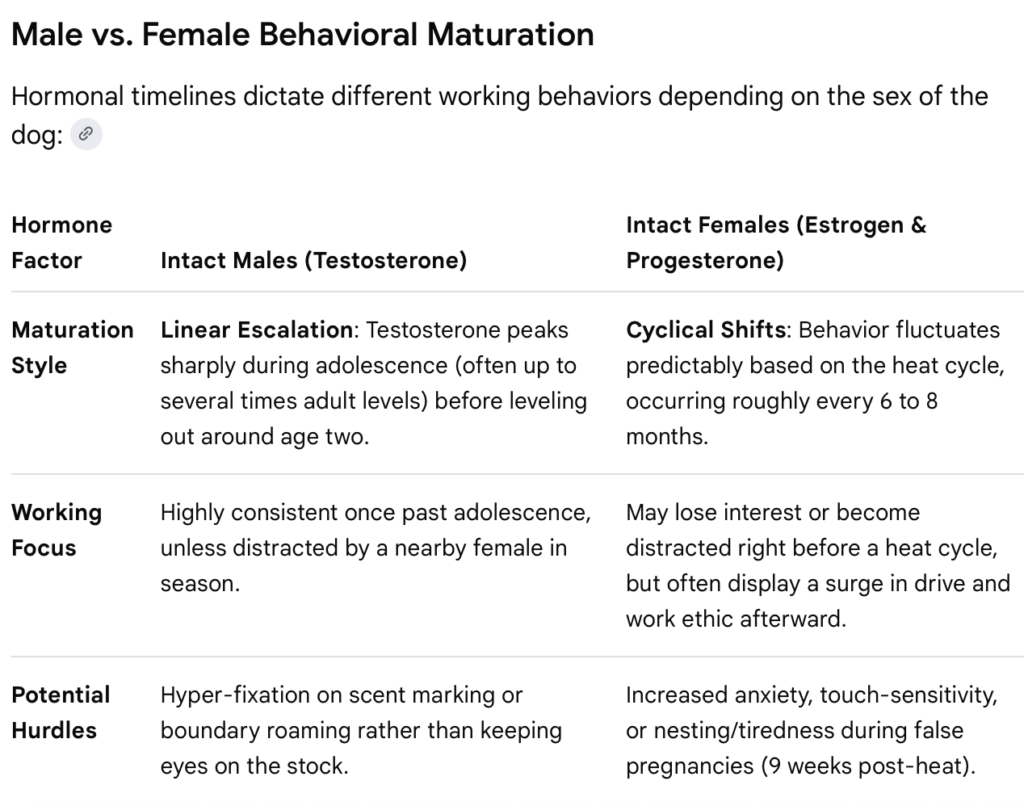
And for those bent on early neutering and spaying….
The Working Impact of Early Neutering
Many livestock producers and trialing handlers delay spaying or neutering until a border collie reaches full social maturity (2 to 3 years of age). Removing gonadal hormones too early can arrest emotional development. This often leaves the dog stuck with a “goofy puppy brain” or a permanent lack of confidence, which can make them more susceptible to noise phobias, fear-aggression, or a lack of determination when challenged by heavy livestock.
I am watching young males now ~9-10 months old who were goody playful and not focused on work finding their mojo on the field. They are changing physically and emotionally in a positive way: they are become working dogs!I
My bad for judging them too early. It reinforces how important testosterone is in males. Again, from ‘Claude’:
“Testosterone in male border collies typically starts rising around <2 to 6 months> of age, with a full surge into adolescent behavioral and sexual maturity hitting between <6 and 12 months>.”
I sell about half my pups into companion homes. And I try to avoid homes where I think the pup will be spayed/neutered early and infantilized. If that is what people looking at dogs from me want, an infantilized dog, they really should be buying an AKC border collie, not a working collie.
10-October-2026